Contaminated Sediment in the Laboratory and Field with GLEC
(0 comments)
For over 30 years, the environmental professionals at Great Lakes Environmental Center, Inc. (GLEC) have provided field and laboratory services, and ecological data analysis to evaluate the health of our nation’s rivers, streams, lakes, coastal areas and wetlands. In particular, we have completed hundreds of projects involving contaminated sediment, and biological surveys at US Environmental Protection Agency (EPA) Areas of Concern, US Army Corps of Engineers (USACE) pre-dredge sediment quality assessments, and industrial sites located throughout the Great Lakes States. GLEC has direct contracts with the USACE-Detroit District, the Department of the Army, multiple US EPA divisions, as well as Master Service Agreements with a wide variety of large environmental engineering firms. GLEC is registered in the System for Award Management (SAM) and is an experienced federal contractor.
To support contaminated sediment quality assessments, GLEC has completed hundreds of projects throughout the Great Lakes region. To borrow a USACE slogan, GLEC’s field and laboratory staff are “in the water, on the water, and next to the water.” GLEC owns and operates a large inventory of specialized field sampling equipment to conduct sediment and surface water sampling including:
• Vibracore sediment sampling equipment, and core/grab sediment samplers
• Drivecore sediment coring equipment
• ARGO amphibious all-terrain vehicle for sediment coring in wetlands and on ice
• 8 survey boats with support trucks, and customized sampling vans
• 4 Great Lakes capable vessels
• 3 electrofishing boats, 3 stream units, and portable (backpack) units
• A wide variety of water quality meters, flow meters, and related sampling equipment
GLEC’s equipment is deployed from one of eight survey boats that range from 14 feet to 25 feet in length. Four of the boats are Great Lakes capable vessels that are used to collect sediment and surface water samples in large bodies of water. Sediment sampling equipment that is frequently used by GLEC on USACE and US EPA projects include dredges (standard Ponar, petite Ponar, and Eckman samplers), gravity corers (GLEW samplers), and 2-inch and 4-inch diameter sediment core sampling equipment that can be advanced using either a vibracore unit or pneumatic drivecore equipment. GLEC’s 25-foot sediment sampling boat has been used at many locations and sediment cores have been collected in water depths as shallow as 12 inches and as deep as 70 feet.
The sediment core systems that are most frequently used by GLEC incorporate either a vibracore unit (electric and pneumatic) or pneumatic drivecore sediment sampling unit. The vibracore unit pictured above weighs 445 pounds and vibrates at 14,000 vibrations per minute. With respect to sediment coring to support dam removal assessment, GLEC typically uses our pneumatic drivecore unit that utilizes a 29-pound pneumatic piston that generates 930 impacts per minute at an air pressure of 100 pounds per square inch and 64 cubic feet per minute. An 8,000 lb. lifting capacity winch is installed on our 25-foot sediment coring boat and is used to remove sediment cores. A 3,000 lb. lifting capacity winch is installed on our wetland coring units (ARGO amphibious tracked vehicle and paired jon boats). On our 25-foot coring boat, the pneumatic drivecore unit can obtain 4-inch OD diameter cores that can range up to 10-12 feet long. During 2024, GLEC purchased a heavy duty electric vibracore unit. This unit weighs 300 pounds and uses an electric motor to produce 3,500 to 5,500 ft-lbs of impact force at a frequency of 1,500 vibrations per minute. GLEC uses the heavy duty vibracore unit to collect 4-inch OD sediment cores up to 15-feet long in soft sediment. Our large electric vibracore unit is used on many pre-dredge sediment quality assessments where sediment cores of up to 15-feet long are needed.
Toxicity Testing to Support Contaminated Sediment Assessment Projects
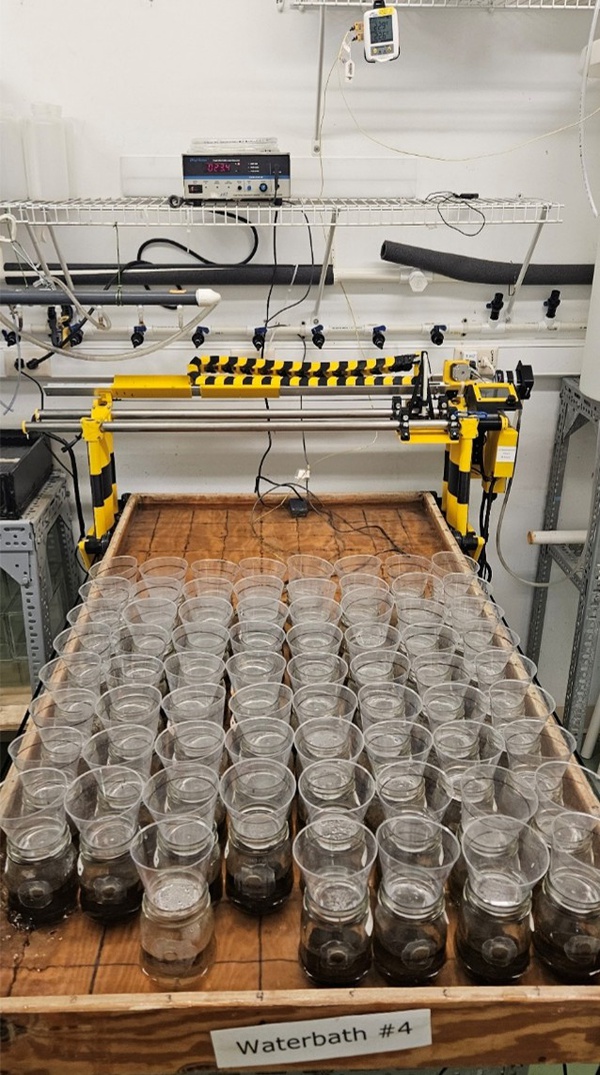
USEPA, USACE, EGLE frequently request the completion of whole sediment toxicity and bioaccumulation testing in conjunction with the assessment of contaminated sediment as well as pre-dredge sediment quality assessments. For nearly 30 years, GLEC has operated two of only a few NELAP accredited laboratories for whole sediment toxicity and bioaccumulation testing. GLEC’s toxicity testing laboratories use whole sediment toxicity and bioaccumulation tests to measure the overall toxicity of a sediment sample by exposing sensitive freshwater test organisms to the actual sediment and comparing specific biological endpoints (e.g., mortality, reduction in growth, reproduction, and chemical accumulation) to the biological endpoints of organisms exposed to a site reference site or GLEC reference control sediment.
The whole sediment toxicity tests and bioaccumulation tests use standardized procedures. GLEC conducts toxicity tests using standard operating procedures, which are based upon the procedures described by EPA/600/R-99/064 Methods for Measuring the Toxicity and Bioaccumulation of Sediment-Associated Contaminants with Freshwater Invertebrates, Second Edition, and ASTM 1706 Standard Test Methods for Measuring the Toxicity of Sediment Associated Contaminants with Freshwater Invertebrates.
Routine freshwater whole sediment toxicity and bioaccumulation tests use the sediment-dwelling organisms, Chironomus dilutus (midges), Hyalella azteca (amphipod), and Lumbriculus variegatus (oligochaete-blackworm). Test organisms are selected based on objectives of the sediment tests. The Chironomid and Hyalella are used to measure the effects of chemicals in the sediment and direct effect on survival, growth or reproduction. Whereas Lumbriculus are used to measure the accumulation of chemicals in the tissue and the potential of those chemicals will transfer through the food web.
GLEC has conducted hundreds of toxicity tests for the USACE Detroit and Buffalo Districts, the USEPA Office of Water, the U.S. Geological Survey, and for State regulatory agencies including the Michigan Department of Environment, Great Lakes, and Energy (EGLE). With respect to whole sediment toxicity testing, over the past 25-years, GLEC has completed whole sediment toxicity testing projects ranging from a few sediment samples to over 400 sediment samples using USEPA whole sediment toxicity testing protocols. Over the past five years, the number of whole sediment toxicity tests that were conducted each year has ranged from 100 to 400 sediment samples. Our laboratories receive samples from all over the United States, US Territories and Canada.
Share on Facebook


Comments
There are currently no comments
New Comment